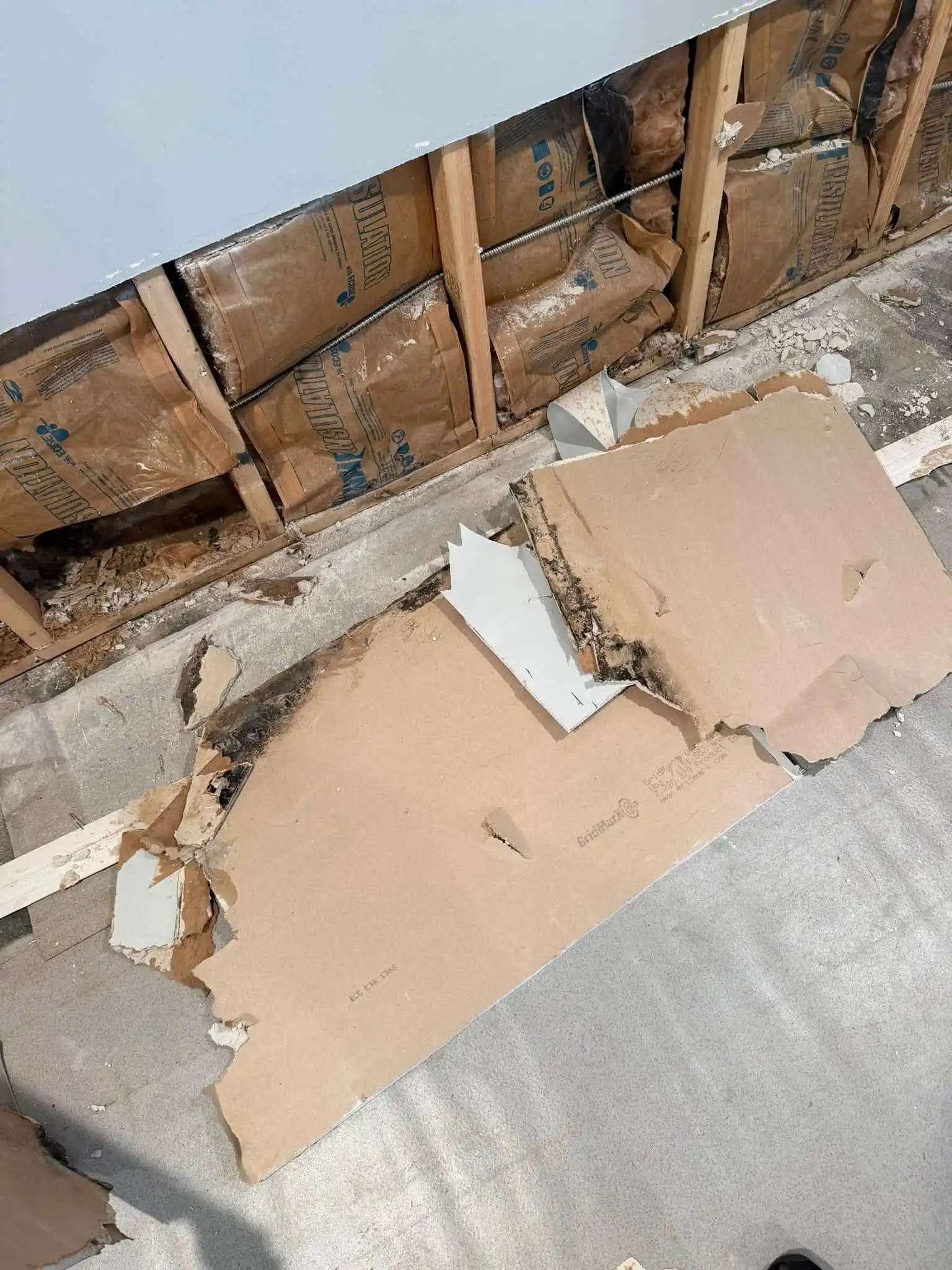
Basement waterproofing problems usually trace to a small number of failure modes, and most of them are invisible on the day the work is signed off.
The most common basement waterproofing failure is drainage stone installed without filter fabric: clay fines silt the bed solid within a few years and the new pipe stops draining. Other frequent failures are interior sealer applied over an active leak, exterior membrane installed without a protective dimple board, and underpinning bays opened out of sequence.
Nobody in this trade publishes this list. We think that is exactly why it is worth publishing.
1. Drainage stone with no filter fabric
The single most common failure, and the cheapest corner to cut.
Perforated pipe is bedded in clear stone so water can move freely into it. The stone has to be wrapped in filter fabric, because Toronto's clay soils release fine particles that migrate with the water.
Without the fabric those fines fill the voids between the stones. Within a few seasons the bed is effectively solid, the pipe stops receiving water, and the basement gets wet again.
The homeowner has a new system, a paid invoice, and the original problem. And because the failure took three or four years, the warranty conversation is usually over.
2. Sealing a wall that is actively leaking
Interior waterproof coatings have a legitimate use on walls managing vapour. They are not a remedy for liquid water arriving under pressure.
Applied over an active leak, the coating delaminates within a season or two. Worse, on block foundations it traps moisture inside the cores, and Toronto's freeze-thaw cycle then works on saturated masonry, accelerating spalling and mortar deterioration.
The wall ends up in worse condition than before the "repair".
3. Exterior membrane with nothing over it
A rubberised asphalt membrane is the waterproofing layer. A dimple board over it is the protection and drainage layer.
Backfill against a bare membrane damages it - angular stone and construction debris tear it during compaction. And without the dimple board's air gap, water sits directly against the membrane under hydrostatic pressure rather than draining to the weeping tile.
An exterior job priced well below $150 to $300 per linear foot is frequently missing this layer.
4. Underpinning bays opened out of sequence
This is the one with real consequences.
Underpinning removes soil from beneath a load-bearing foundation. It is only safe because the work is divided into bays and only a staggered few are ever open, with each pour cured before adjacent bays are cut.
Open too many at once, or open two side by side, and a length of wall is spanning unsupported over an excavation. The results range from cracking and settlement upstairs to, in bad cases, structural failure.
Sequencing is also most of why underpinning takes six to twelve weeks. A quote promising a full basement in two weeks is describing a different, more dangerous job.
5. A sump pump with no backup, and no alarm
An interior drainage system makes your dry basement dependent on a mechanical device.
That device is needed most during severe storms, which is also when the power fails. Without battery backup at $300 to $800, the system is offline at precisely the moment it matters.
And without an alarm, a failed pump is silent until there is water on the floor. In July 2024 a great many Toronto basements with functioning sump pumps flooded anyway, because the pumps had no power. The City subsidises that backup under its Basement Flooding Protection Program.
6. The quote that was never comparable
Not a construction failure, but it costs homeowners more than any of the above.
Two quotes at similar headline rates can differ by $20,000 in scope. On underpinning it is worse: contractors quote against different denominators entirely, and the same job can be presented as $35,000 or $180,000 depending on what is being multiplied - see underpinning cost per linear foot.
What to do with this
Ask any contractor, including us, three questions in writing. Is the drainage stone wrapped in filter fabric. Is a dimple board going over the exterior membrane. What exactly is excluded from this price.
The full list of questions that separate a real contractor from a sales operation is on how to choose a waterproofing contractor, and what we stand behind afterward is on our warranty page.