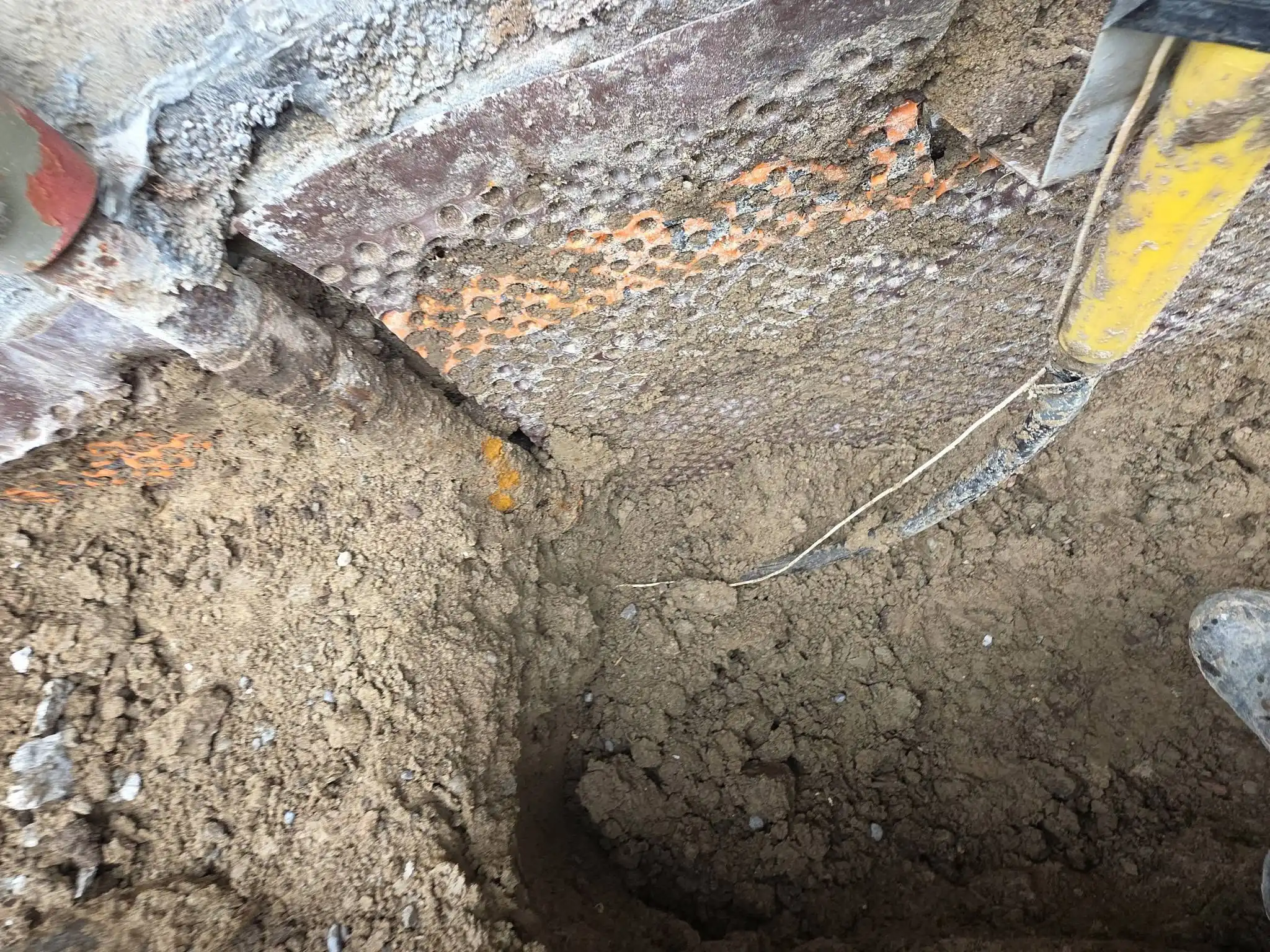
Weeping tile installation replaces the perforated drainage pipe beside your foundation footing - the pipe that collects groundwater and carries it away before it can press against your basement wall.
Weeping tile is perforated pipe laid beside the footing in clear stone and wrapped in filter fabric, collecting groundwater before it reaches the foundation. Replacement is priced within a waterproofing system at $80 to $150 per linear foot inside or $150 to $300 per linear foot outside. In Toronto, 1950s clay tile typically fails at the joints through root intrusion and soil movement rather than by collapsing.
How the same pipe fails in three different eras
This matters more than most homeowners realise, because the age of your house predicts the failure mode, and the failure mode changes the job.
Unglazed clay tile, roughly pre-1960
Short lengths of unglazed clay laid end to end with deliberately open joints - that is how the water got in. There was no filter fabric, because it had not been invented.
Those open joints are also how tree roots get in. Roots find the moisture, enter at the joint, and fill the bore. Meanwhile decades of clay soil movement pull joints apart and let silt in.
The pipe usually looks intact when you excavate it. It simply no longer drains. That is the tile you will find under most of York and Etobicoke, where64.9% of the housing predates 1981.
Bituminous fibre pipe, roughly 1950s to 1970s
Wood pulp bound with pitch - lightweight and cheap. It deforms under soil load over time, going oval and then flattening, and the layers delaminate and peel inward.
This one does fail visibly. Excavate a 1960s Toronto house and you often find pipe you can crush in your hand.
Perforated PVC, roughly 1980 onward
Rigid, rot-proof, and mostly still fine. When a post-1980 house has a wet basement it is usually not the pipe: it is grading, downspouts, window wells, or a silted stone bed where the filter fabric was skipped.
This is why a Mississauga house, where only38.0% of the stock predates 1981, usually needs a different conversation than a York semi.
What a proper installation includes
The pipe is the cheapest part and the part everyone focuses on. The stone bed and the filter fabric are what determine whether the installation is still working in fifteen years.
Clear stone - washed, angular, no fines - creates the void space water moves through. Filter fabric wrapped around that stone keeps clay particles out. Skip the fabric and Toronto's clay soils silt the bed solid within a few years, at which point the new pipe is as useless as the old one.
This is the most common corner cut on a cheap quote, and it is invisible the day the job is finished.
Inside or outside?
Exterior replacement puts new tile where the original went, outside the footing, and lets us waterproof the wall at the same time. It is the better job when access allows it - see exterior waterproofing.
Interior replacement lays new pipe beside the footing under the slab. It drains the same water to the same place and works fine, which is fortunate, because on a great many Toronto semis it is the only option.
Neither addresses surface water sitting in the yard, which is a separate job - see French drain installation.
The old sewer connection
Here is something specific to older Toronto houses that is worth knowing.
Homes built before the 1970s frequently drained their weeping tile straight into the sanitary or combined sewer. That is no longer permitted, and it is a contributor to the sewer surcharging that floods basements during heavy rain.
The City of Toronto subsidises severing and capping that connection, up to $400, under its Basement Flooding Protection Program. Once it is capped the water needs a new destination, which usually means a sump pit - see sump pump installation.
What it costs
| Work | Toronto 2026 range |
|---|---|
| Weeping tile with interior system, per linear foot | $80 to $150 per linear foot |
| Weeping tile with exterior system, per linear foot | $150 to $300 per linear foot |
| Full interior drainage system | $8,000 to $15,000 |
| Full exterior perimeter | $15,000 to $35,000 |
| Severance and capping of sewer connection | Subsidised to $400 |
Note what is and is not subsidised: severance and capping is covered to $400, but full replacement is not covered at all. The distinction is set out on the subsidy page.