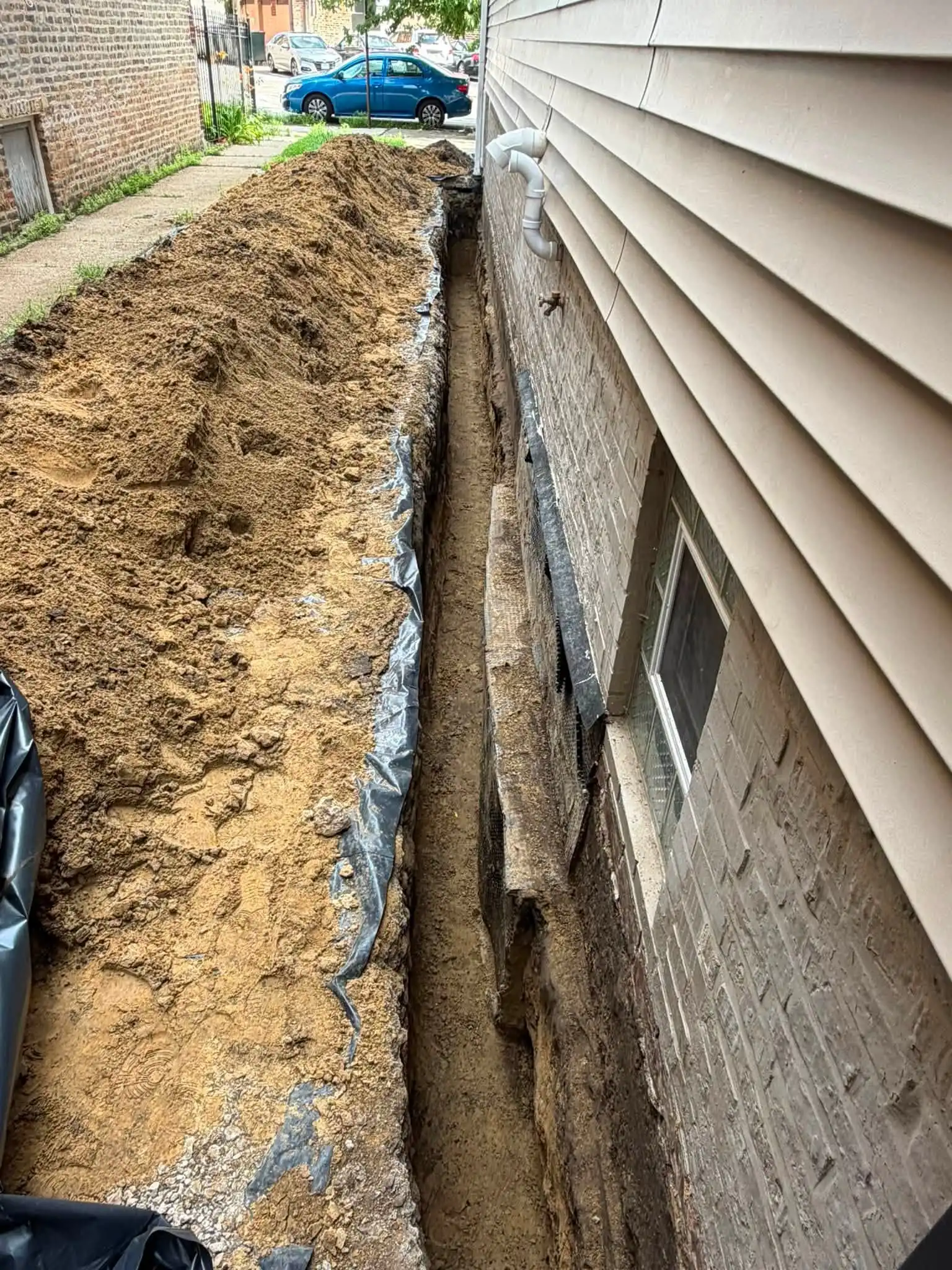
A French drain installation intercepts surface and shallow groundwater in your yard and carries it to a lower discharge point, before it can reach your foundation.
A French drain is a gravel-filled trench containing perforated pipe, wrapped in filter fabric, that collects surface water and moves it to a lower outlet. It handles water in the landscape. Weeping tile, by contrast, sits beside the foundation footing and handles water at the wall. They use the same materials for different jobs.
The distinction that matters
These two get conflated constantly, including by contractors, and the confusion costs homeowners real money.
Weeping tile is a foundation component. It runs beside the footing, below the basement floor level, and its job is to relieve pressure against the wall. Failed weeping tile causes water at the floor-wall joint inside - that is covered on weeping tile installation.
A French drain is a landscape component. It runs wherever the water is pooling, at whatever depth suits, and its job is to stop surface water accumulating. It does not touch the foundation.
If your basement is wet at the floor-wall joint, a French drain in the yard will not fix it. If your lawn is a swamp and water sheets toward the house after every storm, a foundation system is not the answer either. How the two fit together is laid out on our basement drainage overview.
When a French drain is the right tool
A persistently wet, spongy area of yard that stays saturated for days after rain.
A driveway, patio or walkway that sheds water toward the house because it was graded that way or has settled over time.
A neighbouring property higher than yours, sending runoff across the line - common on Toronto's older lots where grades were established long before anyone was thinking about drainage.
And low window wells or basement walkouts that collect water because the surrounding grade funnels it in.
What a proper installation includes
A trench with consistent fall toward the discharge point. Fall is the entire design constraint: without it, the trench becomes a storage tank rather than a drain.
Perforated pipe bedded in clear washed stone, the whole assembly wrapped in filter fabric. As with weeping tile, the fabric is what keeps Toronto's clay fines out of the stone. Omit it and the drain silts up within a few seasons.
And a legal discharge point with somewhere for the water to actually go - a lower part of the property, a dry well, or where permitted a storm connection. Never onto a neighbour's land, and never into the sanitary sewer.
Why we will not publish a price range
We publish verified ranges for almost everything else on this site. Not this one, and it is worth explaining why.
French drain cost is driven by length, depth, and whether a viable discharge point exists - and that last variable is binary rather than incremental. A property with natural fall to a rear low point is straightforward. A flat lot with no outlet may need a dry well or a pumped system, which is a different project at a different price.
Any published per-foot figure would be misleading on half of Toronto's lots, so this is quoted per site after we have looked at the grades.
The parts, by name
A French drain is four components, and quotes differ mostly in which of them get left out. The pipe is either rigid perforated PVC or corrugated flexible pipe, and rigid holds its shape under load where corrugated can deform and collect silt at the low points.
Around it goes clear stone, meaning washed angular aggregate with the fines screened out. Angular matters: rounded pea gravel packs tighter and leaves less void space for water to move through.
Wrapping the stone is geotextile filter fabric, a non-woven membrane that passes water and holds back the clay fines that would otherwise fill the voids. This is the component most often skipped, and the one that decides whether the drain is still working in ten years.
Then the outlet: a daylight discharge where the grade allows one, or a dry well or catch basin where it does not. A cleanout riser at the upstream end lets the run be flushed later, which matters because nobody rebuilds a silted drain that has no access point.
Cheaper things to check first
Before a French drain, check where your downspouts discharge. A downspout dumping beside the foundation delivers an enormous volume of water to the worst possible place, and extensions cost very little.
Then check the grade in the first two metres around the house. Soil settles and gardens get built up over decades until the ground slopes toward the wall. Regrading is often under $2,000 and resolves a surprising number of drainage complaints.
| Work | Toronto 2026 range |
|---|---|
| French drain | Quoted per site |
| Window well drain, per window | $500 to $1,500 per window |
| Weeping tile, exterior, per linear foot | $150 to $300 per linear foot |
| Regrading away from the foundation | Often under $2,000 |
If the water is reaching your basement rather than sitting in the yard, start with exterior waterproofing instead.