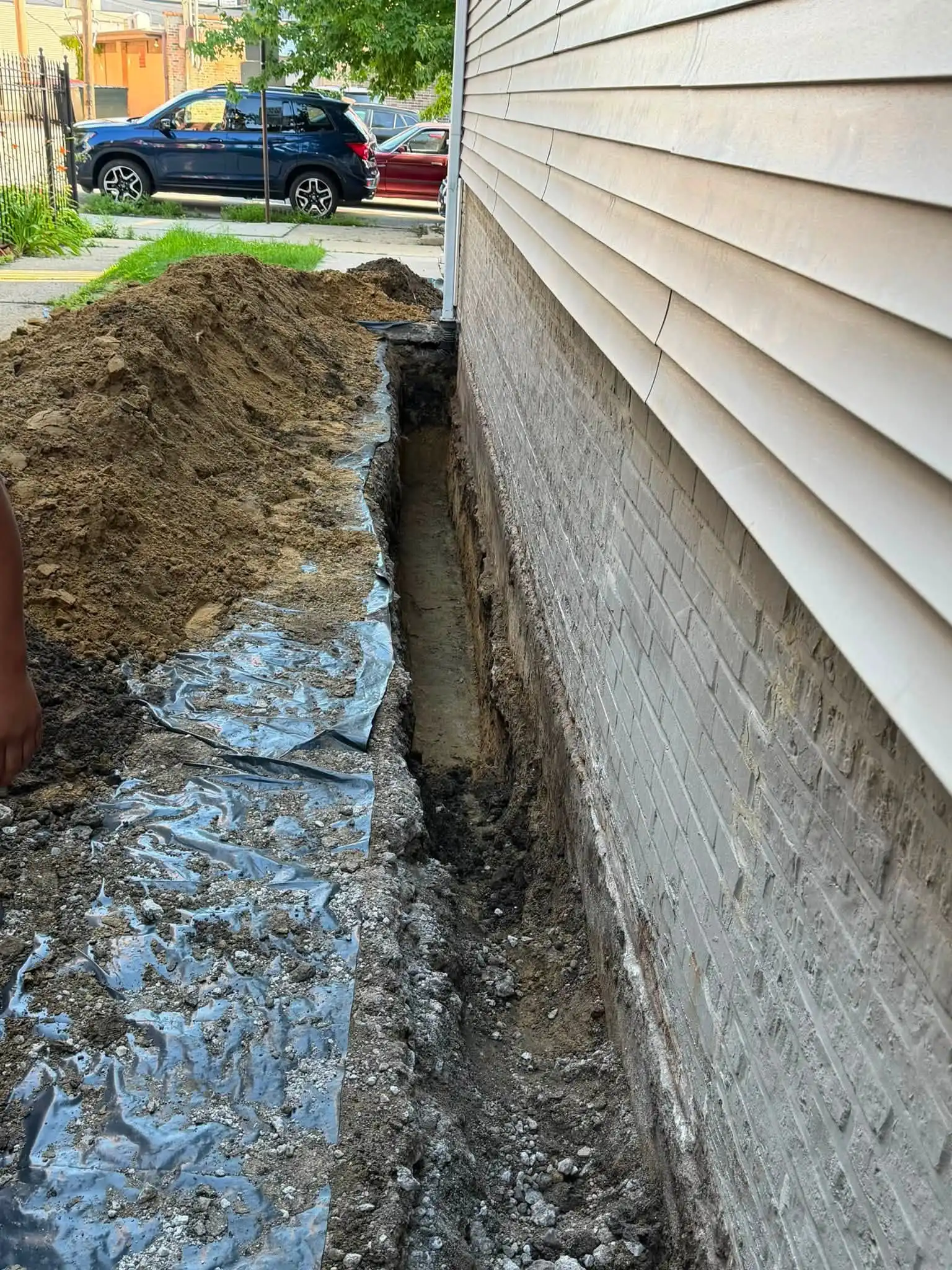
A basement drainage system moves groundwater away from your foundation before it can build pressure against the wall or push up under the slab.
A complete basement drainage system has four parts: weeping tile at the footing bedded in clear stone and filter fabric, a sump pit and pump where gravity discharge is not available, a backwater valve protecting against sewer surcharge, and properly discharged downspouts. In Toronto a sump pump is $650 to $4,000 installed and a backwater valve $2,000 to $4,500, both partly subsidised by the City.
How the parts fit together
Each part depends on the one after it. Weeping tile with nowhere to discharge does nothing. A sump pump with no battery backup fails during the storm and power cut that most needs it.
Weeping tile
The perforated pipe running beside your footing, collecting groundwater before it reaches the wall. Every house in Toronto has some version of it, and on pre-1980 housing a great deal of it no longer works.
The failure mode depends on the era. 1950s clay tile fails at the joints - tree roots find them, and soil movement pulls them apart. It rarely collapses; it just silently stops draining. Later bituminous fibre pipe deforms oval under load and delaminates.
Full detail on replacement and why the stone bed matters as much as the pipe is on weeping tile installation.
Sump pumps
Where the weeping tile cannot fall to a sewer or a low point on the property by gravity, it discharges into a sump pit and gets pumped out.
This became far more common after municipalities stopped permitting weeping tile connections into the sanitary sewer. Severing that old connection is one of the items the City of Toronto subsidises, and once it is capped, most houses need a pit.
Installed cost is $650 to $4,000 depending on whether a pit has to be excavated. See sump pump installation.
Backwater valves
Different problem entirely, and it is worth being clear about it. A backwater valve does nothing about groundwater. It protects against the city sewer backing up into your house during a surcharge.
That is what happened across Toronto in July 2024, when flash flooding caused over $940 million in insured damage. Sewers surcharged, and houses without valves took sewage through their floor drains.
At $2,000 to $4,500 installed, with up to $1,600 per device subsidised, this is the highest-value single item on this page for most Toronto homeowners. See backwater valve installation.
Window wells
Small item, disproportionate share of wet basements. A window well without a working drain fills during heavy rain and pushes water over the sill.
A drain connected down to the footing drainage costs $500 to $1,500 per window. If your basement leaks near a window, check this before anything else.
What it costs, and what the City pays for
| Work | Toronto 2026 range |
|---|---|
| Weeping tile, interior, per linear foot | $80 to $150 per linear foot |
| Weeping tile, exterior, per linear foot | $150 to $300 per linear foot |
| Sump pump installed | $650 to $4,000 |
| Battery backup | $300 to $800 |
| Backwater valve installed | $2,000 to $4,500 |
| Window well drain, per window | $500 to $1,500 per window |
The City of Toronto subsidy is genuinely useful and widely misrepresented. What it covers, what it does not, and how to claim it is set out on the Toronto Basement Flooding Protection Subsidy page.
For surface water rather than foundation water - a wet yard, a low patio, a driveway that drains toward the house - see French drain installation.