Skip to content

Free on-site assessments across Etobicoke, Toronto and MississaugaCall (647) 584-9600

DEEPLINEWATERPROOFING
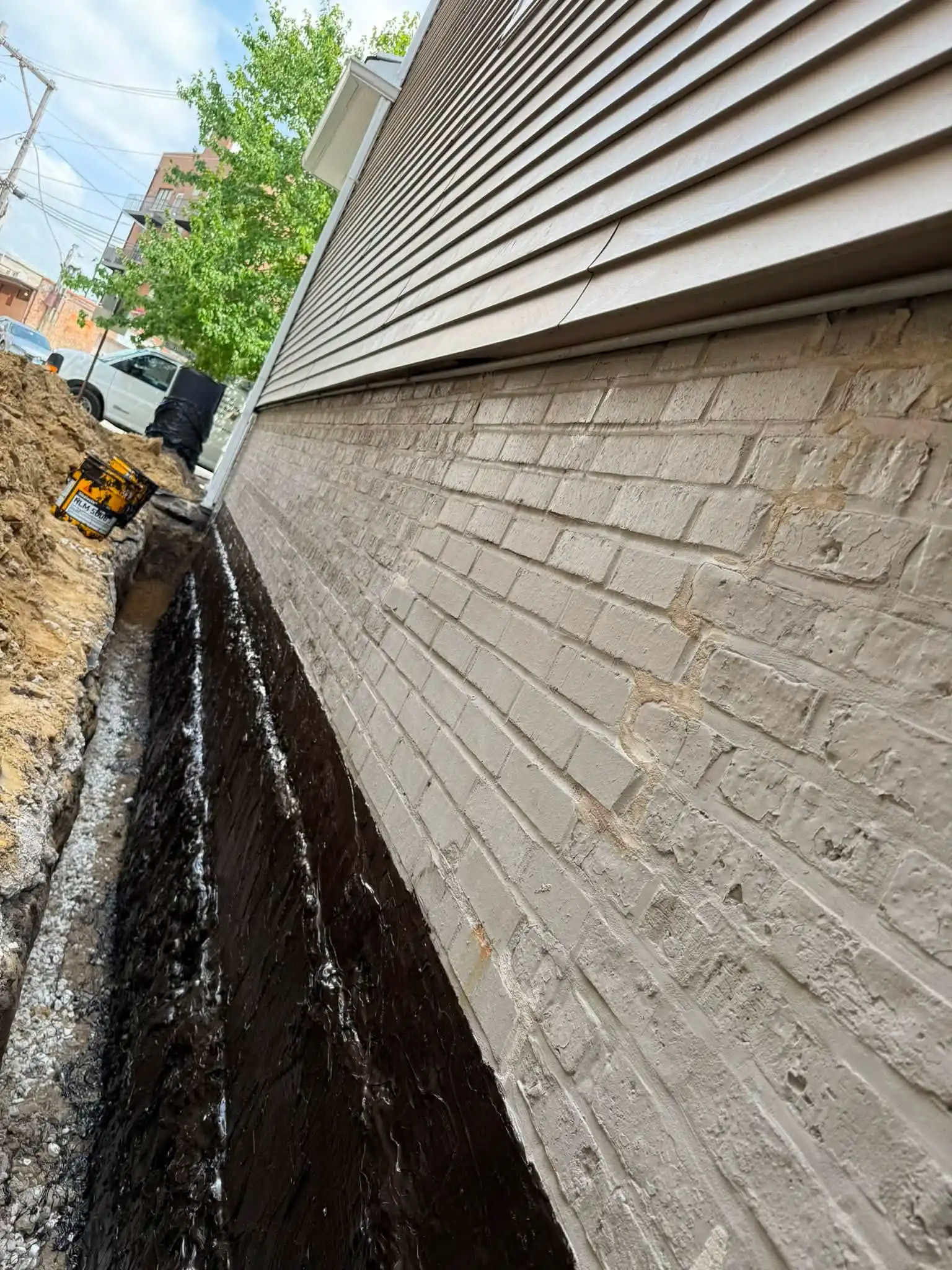
Rubberised waterproofing membrane being applied to a painted brick foundation wall in an open trench, Etobicoke
Exterior Waterproofing Toronto

Stop Water Before It Reaches the Wall

Exterior waterproofing excavates to the footing, seals the outside face of the foundation, and rebuilds the drainage beside it. It is the more complete fix, and the more disruptive one.

Office at 66 Jutland Rd, EtobicokeVisit us to discuss your project
Free on-site assessmentWe walk the basement before quoting
Etobicoke · Toronto · MississaugaPlus North York, York, East York
TODO-7: licence numbers · TODO-8: insurance

Exterior waterproofing in Toronto excavates the soil against your foundation down to the footing, seals the outside face of the wall, and lays a new drainage layer beside it so groundwater is carried away before it can enter.

Exterior waterproofing in Toronto costs $150 to $300 per linear foot of foundation wall, or $15,000 to $35,000 for a full perimeter. The work involves excavating to the footing, applying a rubberised asphalt membrane, installing a dimple board such as Platon over it, and laying new weeping tile in clear stone wrapped in filter fabric.

What actually goes on the wall

Three layers, and all three matter. Contractors cutting price usually cut one of them.

The membrane

A spray- or trowel-applied rubberised asphalt coating, bonded directly to the cleaned foundation. This is the actual waterproofing. It has to be continuous, carried down over the footing joint, and applied at the specified thickness.

The dimple board

A high-density polyethylene sheet — Platon and Delta-MS are the common brands — with moulded dimples that hold it off the wall. The air gap it creates lets any water that reaches it run straight down to the drain rather than sitting against the membrane under pressure.

It also protects the membrane from being torn by backfill, which is how a membrane-only job typically fails within a few years.

The drainage layer

New perforated weeping tile at the footing, bedded in clear stone, wrapped in filter fabric. Without the fabric the stone silts up with clay fines and the pipe stops draining. This is covered fully onweeping tile installation.

How it compares to working inside

Interior versus exterior basement waterproofing, shown in cutaway Two cutaways of the same foundation wall. Exterior waterproofing excavates the outside of the wall, applies a membrane and dimple board to the outside face, and lays new weeping tile in gravel beside the footing, so water is stopped before it reaches the wall. Interior waterproofing breaks the slab inside, lays a drain pipe beside the footing inside, and routes water to a sump pump, so water passes through the wall and is then collected and pumped out.Exterior WaterproofingStops water before it reaches the wallGradeexcavated, then backfilledinsidegroundwaternew weeping tilein clear stonemembrane +dimple boardWater never enters the wall. Requires fullexcavation to the footing, outside.Interior WaterproofingCollects water once it is through, and pumps it outundisturbed — no excavationgroundwaterpumped outWater passes through the wall, then is caughtat the footing and pumped to the sump.$150 – $300 per linear foot · $15,000 – $35,000 full perimeter$80 – $150 per linear foot · $8,000 – $15,000 full system
The same wall, treated two ways. Exterior work keeps water out of the structure entirely but requires digging to the footing. Interior work lets water reach the wall and then manages it, at roughly half the cost and with no excavation outside. Neither is universally correct — see the comparison below.

The core difference: exterior work keeps the foundation itself dry. That matters most on block foundations, where saturated cores lead to efflorescence, spalling and eventually mortar failure.

On a poured concrete wall in good condition, an interior system at roughly half the price often delivers a dry basement just as reliably. We say so onthe interior pagerather than pushing everyone toward the bigger job.

What makes a Toronto job expensive

Access, almost always. A detached house with a driveway wide enough for a mini excavator is a fundamentally different job from a semi with a three-foot shared walkway where every bucket of clay comes out by wheelbarrow.

Depth is the second factor. Deeper basements mean more excavation, more shoring, and more soil to remove and replace.

Reinstatement is the third and the one homeowners forget. Interlock, decks, steps, fencing and mature planting all have to come out and go back. On some properties that is a larger line than the waterproofing.

What it costs

WorkToronto 2026 range
Exterior membrane waterproofing$150 to $300 per linear foot
Full perimeter exterior system$15,000 to $35,000
Weeping tile replacement while openUsually included in the per-foot rate
Window well drain, per window$500 to $1,500 per window
Crack injection from outside, per crack$450 to $1,100 per crack
Verified Toronto market ranges for 2026. Market ranges, not a quote — depth, access and reinstatement decide where a specific house lands.

Note that none of this attracts the City of Toronto Basement Flooding Protection Subsidy. That programme covers devices, not waterproofing systems, and the full breakdown is on thewaterproofing cost page.

Exterior Waterproofing: Common Questions

How much does exterior waterproofing cost in Toronto?

Exterior waterproofing in Toronto costs $150 to $300 per linear foot of foundation wall, with a full perimeter running $15,000 to $35,000. The range is driven by excavation depth, access for machinery, and what has to be removed and reinstated above — decks, patios, interlock and mature planting all add cost.

What is the difference between tar and a membrane?

Spray-applied rubberised asphalt is the waterproofing layer itself; it bonds to the wall and seals it. A dimple board such as Platon is a drainage and protection layer installed over it, which creates an air gap so water runs down to the weeping tile rather than sitting against the membrane. A proper exterior job uses both. Tar alone, with nothing over it, is a damp-proofing detail, not waterproofing.

Do you have to dig up the whole yard?

Only the ground directly against the foundation being treated, typically a trench three to four feet wide running down to the footing. It is disruptive but it is not the whole yard. Where the leak is confined to one wall, we excavate that wall alone rather than the full perimeter.

Can exterior waterproofing be done in winter in Toronto?

It can, but it is harder and sometimes should not be. Frozen ground slows excavation and raises cost, and most spray-applied membranes have minimum application temperatures. Where the work is not urgent, exterior waterproofing is better scheduled between spring and late autumn.

Will exterior waterproofing fix a structural crack?

It will stop that crack leaking, but it does not address why the crack formed. A crack caused by settlement or lateral soil pressure needs a structural assessment and often carbon fibre or steel reinforcement. Sealing the outside of a moving crack simply postpones the reappearance of the leak.

Find out whether exterior work is worth it on your house

Access, depth and what sits above the foundation decide this. We will look before we quote.

Call (647) 584-9600