Skip to content

Free on-site assessments across Etobicoke, Toronto and MississaugaCall (647) 584-9600

DEEPLINEWATERPROOFING
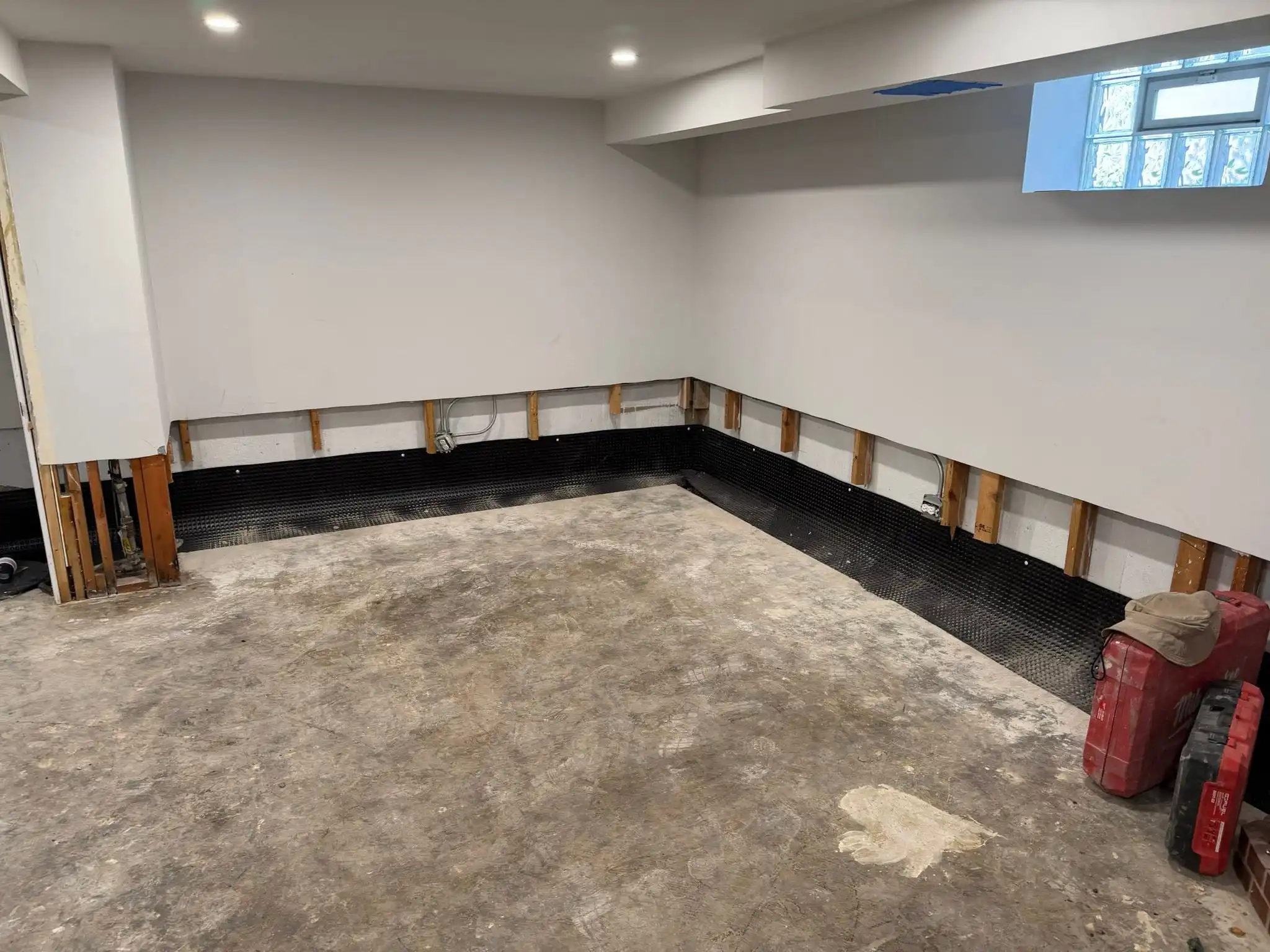
Interior basement perimeter with drainage membrane installed along the base of the foundation wall, Toronto
Interior Waterproofing Toronto

When Digging Outside Isn't Possible

Interior waterproofing breaks the slab along the footing, lays a drain, and routes water to a sump pump. It costs roughly half what exterior work costs and never touches your yard.

Office at 66 Jutland Rd, EtobicokeVisit us to discuss your project
Free on-site assessmentWe walk the basement before quoting
Etobicoke · Toronto · MississaugaPlus North York, York, East York
TODO-7: licence numbers · TODO-8: insurance

Interior waterproofing in Toronto manages water after it reaches your foundation rather than stopping it outside. The slab is broken open along the footing, a drain is laid, and everything is routed to a sump pump.

Interior waterproofing in Toronto runs $80 to $150 per linear foot of foundation wall, or $8,000 to $15,000 for a full system. The work involves breaking the perimeter slab, laying perforated drain pipe in clear stone beside the footing, fitting a dimple membrane up the wall, connecting to a sump pit, and repouring concrete. It takes three to six days and requires no excavation outside.

Why most Toronto houses end up here

Not because it is better. Because digging is often impossible.

A large share of this city's housing is semi-detached and row stock on narrow lots, with shared walkways three or four feet wide, no rear access, and a neighbour's wall within arm's reach. You cannot get an excavator in, and hand digging a full perimeter to footing depth costs more than the house needs to spend.

Then there is everything sitting on top of the foundation — interlock, decks, steps, a driveway, thirty years of established garden. Removing and reinstating all of it frequently costs more than the waterproofing itself.

What a proper installation includes

The slab is cut and broken back roughly 12 to 18 inches from the wall, right down to the footing.

Perforated pipe is laid beside the footing — not on top of it — bedded in clear stone and wrapped in filter fabric so clay fines cannot silt it up.

A dimple membrane runs up the inside face of the wall and turns down into the stone bed, so any water coming through the wall is caught and directed into the drain rather than tracking across the floor.

The pipe falls to a sump pit, and a pump discharges it away from the house. Fresh concrete goes back over the trench.

Interior versus exterior basement waterproofing, shown in cutaway Two cutaways of the same foundation wall. Exterior waterproofing excavates the outside of the wall, applies a membrane and dimple board to the outside face, and lays new weeping tile in gravel beside the footing, so water is stopped before it reaches the wall. Interior waterproofing breaks the slab inside, lays a drain pipe beside the footing inside, and routes water to a sump pump, so water passes through the wall and is then collected and pumped out.Exterior WaterproofingStops water before it reaches the wallGradeexcavated, then backfilledinsidegroundwaternew weeping tilein clear stonemembrane +dimple boardWater never enters the wall. Requires fullexcavation to the footing, outside.Interior WaterproofingCollects water once it is through, and pumps it outundisturbed — no excavationgroundwaterpumped outWater passes through the wall, then is caughtat the footing and pumped to the sump.$150 – $300 per linear foot · $15,000 – $35,000 full perimeter$80 – $150 per linear foot · $8,000 – $15,000 full system
The same wall, treated two ways. Exterior work keeps water out of the structure entirely but requires digging to the footing. Interior work lets water reach the wall and then manages it, at roughly half the cost and with no excavation outside. Neither is universally correct — see the comparison below.

The honest limitations

Two, and neither is a reason to avoid interior work — just to understand it.

First, the wall still gets wet. On a poured concrete foundation that is largely cosmetic. On a block foundation, water sitting in the cores over years produces efflorescence, spalling and eventually mortar deterioration. If your foundation is block and you can dig, exterior waterproofingis the more durable answer.

Second, you now depend on a pump. A sump pump is a mechanical device with a finite service life, and it fails during exactly the storm that needs it, often while the power is out. A battery backup at $300 to $800 is not optional on a system your dry basement depends on — seesump pump installation.

What it costs

WorkToronto 2026 range
Interior membrane and drain channel$80 to $150 per linear foot
Full interior drainage system$8,000 to $15,000
Sump pump installed$650 to $4,000
Battery backup for the pump$300 to $800
Crack injection, per crack$450 to $1,100 per crack
Verified Toronto market ranges for 2026. Note the sump pump and battery backup attract City of Toronto subsidy; the waterproofing itself does not.

One genuinely useful detail: the sump pump and its battery backup are covered by the City of Toronto Basement Flooding Protection Subsidy, up to $2,250 and $300 respectively. The interior waterproofing system they are attached to is not covered at all.

Interior Waterproofing: Common Questions

How much does interior waterproofing cost in Toronto?

Interior waterproofing in Toronto costs $80 to $150 per linear foot of foundation wall. A full interior drainage system for an average basement runs $8,000 to $15,000, including breaking the slab, laying drain pipe at the footing, installing membrane, connecting to a sump pit and repouring concrete.

Does interior waterproofing actually work?

Yes, for its intended purpose, which is keeping the basement dry rather than keeping the wall dry. Water still reaches the foundation, then runs down the interior membrane into a drain at the footing and out through a sump pump. The floor stays dry and the finished space is protected. What it does not do is stop the wall itself from getting wet.

Does interior waterproofing need a sump pump?

Almost always. The interior drain has to discharge somewhere, and unless your basement sits high enough to drain by gravity, that means a sump pit and pump. This introduces a mechanical component with a finite life, which is the main long-term difference from exterior work.

How long does interior waterproofing take?

Typically three to six days for an average Toronto basement. Day one is breaking out the perimeter slab, then the drain and membrane go in, then the concrete is repoured and left to cure. It is dusty and loud but far less disruptive to the property than excavating outside.

Can interior waterproofing be done in a finished basement?

Yes, but the bottom of the finished walls has to come off first — typically the lowest 12 to 24 inches of drywall, insulation and baseboard along every wall being treated. Budget for that removal and for reinstating it afterward, because it is rarely included in a headline per-foot price.

Find out what your basement needs

We trace where the water is entering first. Sometimes the answer is a $600 crack injection, not a $12,000 system.

Call (647) 584-9600