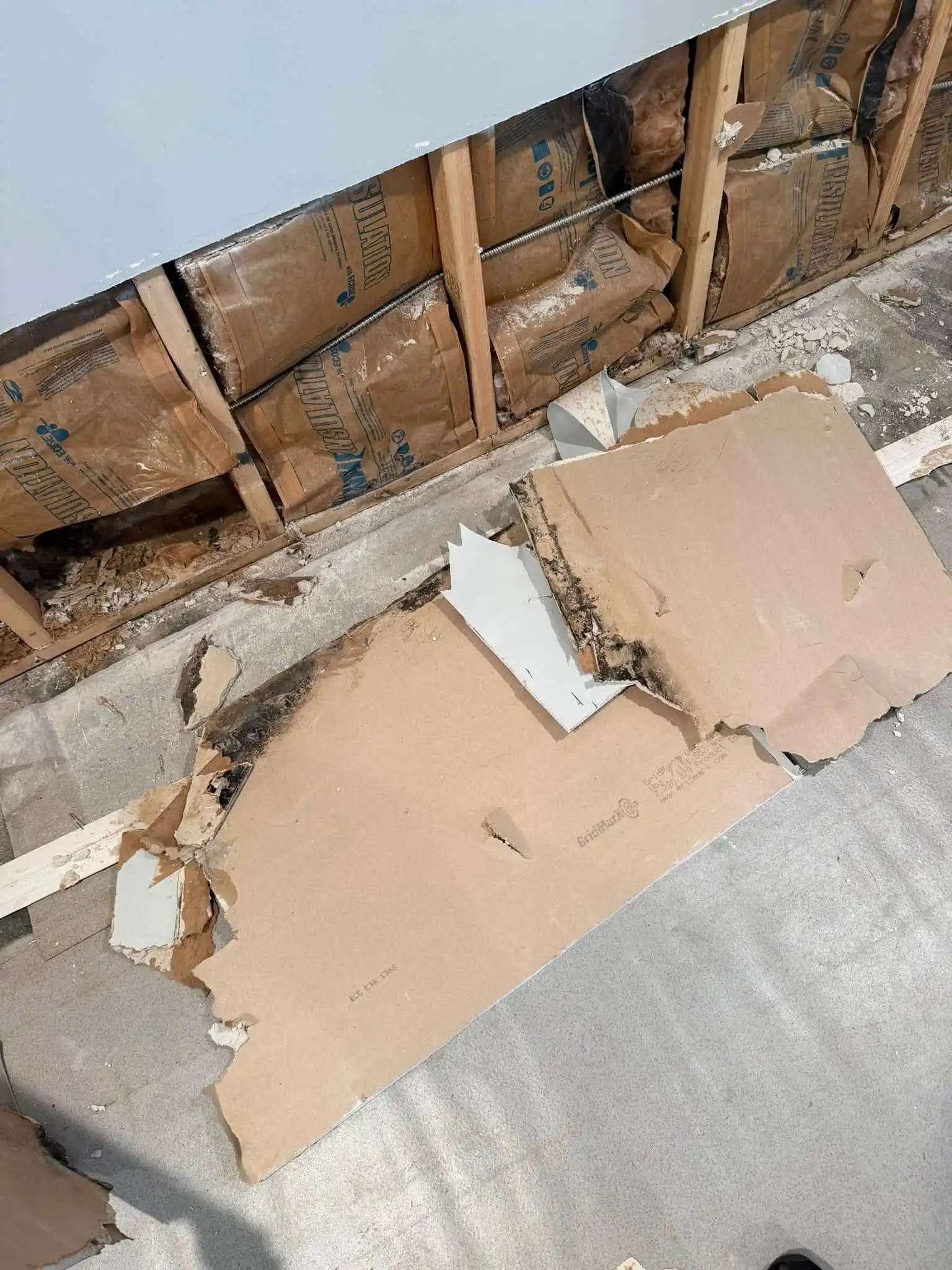
Basement leak repair in Toronto begins with locating the entry point, which is almost never where the water ends up on the floor.
A single leaking foundation crack costs $450 to $1,100 per crack to repair by injection, and a leaking window well $500 to $1,500 per window. Water entering at one identifiable point is a repair. Water appearing along the floor-wall joint on multiple walls indicates failed footing drainage, which is a system problem costing $8,000 to $15,000 or more.
Point-source leak, or system failure?
This is the only question that matters at the start, because the two answers are an order of magnitude apart in cost.
A point-source leak has a single identifiable entry: a crack, a pipe penetration, a window well, a gap where an old coal chute was filled in. There is usually a visible trail of staining or efflorescence leading down and away from it.
A system failure shows up as water at the joint where the floor meets the wall, typically on more than one wall, often appearing under the slab as much as through it. That is hydrostatic pressure, and no amount of patching addresses it.
How we trace it
Water runs down and sideways before it pools. The wet patch is evidence of where the water stopped, not where it started.
So we look for the highest point of staining on the wall, any efflorescence trail - that chalky white mineral deposit left as water evaporates through masonry - and rust marks on fasteners or steel.
Then outside, at that same location: where the downspouts discharge, which way the ground falls in the two metres closest to the house, the condition of any window well, and whether there is a visible crack in the exposed foundation.
In a finished basement this often means opening a small section of wall. That is worth doing before spending five figures on the wrong solution.
Repairing a leaking crack
Most single-point foundation leaks in Toronto are cracks, and most cracks are injectable.
Polyurethane resin is injected under pressure through ports set along the crack, filling it through the full thickness of the wall and expanding as it cures. Polyurethane stays slightly flexible, which suits a crack that may move seasonally. Epoxy is rigid and stronger, used where the repair also needs to restore structural continuity.
Injection at $450 to $1,100 per crack is a permanent fix on a stable crack. On a crack that is still moving, it will reopen - which is why the cause gets assessed first, and why foundation crack repair covers how to tell a cosmetic crack from a structural one.
When the leak is at a window well
Common, and commonly misread. A well with no drain, or one whose drain has silted up, fills during heavy rain and pushes water over the sill.
Because that water then tracks along the wall cavity, the visible damage often appears several feet from the window, and people conclude the foundation is failing. A drain at $500 to $1,500 per window resolves it.
When it turns out to be the drainage
Sometimes the honest answer is that there is no single leak to repair.
If your weeping tile has failed - and on Toronto's pre-1980 housing stock a great deal of it has - water builds against the whole foundation and finds every available path. Sealing one of them just moves the problem along the wall.
At that point the conversation moves to a drainage system, and the wider set of causes is laid out on wet basement repair.
What it costs
| Work | Toronto 2026 range |
|---|---|
| Crack injection, per crack | $450 to $1,100 per crack |
| Window well drain, per window | $500 to $1,500 per window |
| Exterior spot repair at one wall | $150 to $300 per linear foot |
| Full interior drainage system | $8,000 to $15,000 |
Where a leak is confined to one wall and the exterior is accessible, a targeted excavation of that wall alone is often far cheaper than a full perimeter - the approach is covered on exterior waterproofing.